


EHSA News
The English High Years of its Most Illustrious Alumnus
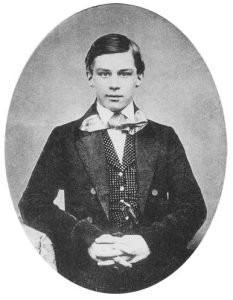
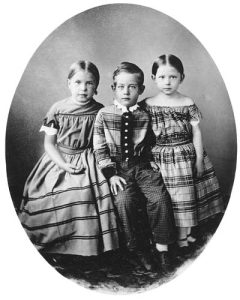
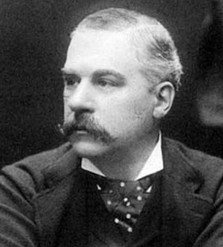
John Pierpont Morgan – EHS Class of 1854
In terms of sheer impact upon our national life, there is little question that John Pierpont Morgan, EHS Class of 1854, would earn the above title. At the same time, he remains a figure of controversy among the numerous writers who have dealt with his life and actions, characterized by some as the premier “robber baron” of the so-called Gilded Age, with others laying stress on the more positive aspects of his legacy.
On the one hand, Morgan’s business tactics were described by many as ruthless, his accumulation of money and power secured by means of an anti-competitive strategy which employed controlling trusts and manipulation of stocks in a variety of the nation’s most important industries. At the same time, there are his undeniable contributions to some of America’s most important cultural institutions both through extensive philanthropy and his personal leadership and service. Morgan donated over 7,000 items from his extraordinary art collection at the founding of New York’s Metropolitan Museum of Art, serving as its president and trustee and described as the driving force behind its early rise to prominence. He was also a founder of the American Museum of Natural History, serving on its board of trustees for 44 years and funding the acquisition of gemstones and invaluable artifacts from throughout the world.
Further, while it is hardly possible to cast Morgan’s business activity in an overly benign light, it is historical fact that on more than one occasion, he employed his vast wealth and influence in the interest of stabilizing the American economy in time it faced great peril. He played a key role in preventing financial disaster which loomed during the Panic of 1893 when after meeting with President Grover Cleveland, Morgan effectively rescued the U. S. Treasury by underwriting its dwindling gold reserves. Fourteen years later, when economic crisis again threatened, he gathered the nation’s leading bankers and strong-armed them into providing funding to shore up failing banks and avert an impending stock market collapse.
Looking at the roots of the man Morgan would begin with his boyhood in Hartford, Connecticut where he was born in April of 1837. His family had enjoyed several generations of wealth with interests in banking and insurance, and he spent his early years attending several private boarding schools in the area. Morgan’s father who was active in cultivating business relationships beyond Hartford secured an advantageous partnership in Boston and in 1851, moved his family to a residence at 15 Pemberton Square, the present site of the Suffolk County Courthouse. Young Pierpont, as he was called, shared a strong family history with both the city and our school. Both sides of his family had initially settled in Roxbury upon their arrival in this country, and his maternal grandfather, John Pierpont, a minister and educator, had been instrumental in the founding in 1821 of The English Classical School as it originally was known.
 After passing the entrance exam, Morgan entered English High’s Bedford Street building in the fall of 1851 at age fourteen. While initially saddened to have left Hartford, he was to note within a few weeks that he had begun “to like school very well.” His grades were good and he stood in that first year eleventh in rank in his class of thirty-three students.
At his young age, it may be possible to discern certain traits and habits of the later adult. In an essay of his which has been preserved entitled “Thoughts and Resolutions on Entering English High School,” Morgan asserts his intention to go straight into business after graduation. He also expresses his determination “to act and think in all cases for myself” and stresses the centrality of good character to securing and keeping a position in the business world. This youthful assertion presages the famous pronouncement that an aging Morgan was to make when he spoke before Congress over a half a century later: “the first thing in credit is character … before money or anything else.”
In other of his school essays which have been preserved, Morgan speaks of the critical importance of commerce in having transformed the nation from forest and wilderness, “com[ing] to aid us … bringing the wares of other shores to us and taking theirs to ours,” and highlighting especially the advent of train service, an industry in which he was to play a pivotal national role. In another, he decried the existence of slavery, a sentiment shared by many in Boston in that troubled decade, while also expressing concern for the survival of the federal union.
Morgan had suffered bouts of illness throughout his childhood, and a severe attack of rheumatic fever prevented his return to the high school the following year. Convinced that a different climate would benefit their son, his parents arranged for him to travel to the Azores in the care of a business friend who was U. S. consul. His health improved through the months there, and by spring he was well enough to begin his return. He met up with his parents in London and, reflective of his family wealth, was treated to a tour over several weeks of England, France and Germany.
Upon his return to Boston, a now more robust Morgan was allowed to rejoin his classmates for what would be his final high school year. The principal had concluded, it appears on slim basis, that he had kept up with his studies while overseas, although it is conjectured that he determined that the boy’s wide travel experience had been sufficiently broadening.
Morgan’s senior courses included Astronomy, Theology, Moral Philosophy, and Evidences of Christianity which he complained in a letter to a friend in Hartford were “not only very hard indeed but very dull.” He added “I scarcely ever touch my pillow before 11 or 12 o’clock,” asserting “I have to study about all the time,” contrasting his academic workload to what he had experienced prior to attending English High. Despite his complaints, it’s apparent that he did in those years become very familiar with the city, visiting historic and cultural sites, and attending concerts, talks, and plays, including a stage production of “Uncle Tom’s Cabin.”
Morgan’s relationship with his fellow English High students is not so well preserved for posterity. One biographer has asserted that he was viewed as aloof and something of a dandy, and it is recorded that as a mere high schooler, he purchased a pair or costly handmade boots from a Paris shop, his order written in fluent French. It was noted that during his high school years that he enjoyed playing chess and also whist and backgammon, and that he showed a characteristic drive to win in all of these. In a reminisce about Morgan published in the Boston Globe in 1906, none among his classmates noted strong recollections of the now famous business colossus, though one mentioned his status as the richest student in the class.
As Morgan approached graduation, he benefited from what was considered as good a secondary education as offered by any school in America, with particular emphasis on mathematics. Notwithstanding his junior year-long hiatus in Europe, he had made a creditable showing, finishing twelfth out of 26 in his class.
Graduating students were required to draft and read aloud their primary graduation essay to an audience of teachers, fellow students and their families. Morgan’s English High School years came to an end on July 24, 1854 with delivery of his “Exhibition Day” address. Diverging from his fellow students whose orations addressed moral principles or the lives of icons of American independence, Morgan chose as his topic the life of Napoleon. It is not surprising that in assessing his subject’s accomplishments the seventeen-year-old writer focused emphatically upon his indomitable will, declaring: “no obstacles fell in his way which seemed insurmountable…”
Morgan departed the school to head to Europe where he was to spend the next three years as a student, first in Switzerland and then at the University of Gottingen in Germany. His later involvement with his Alma mater was minimal according to classmates who observed that he never appeared for any school events or reunions. One recalled that he had been invited to participate in English High School’s semicentennial celebration in 1871 but had not come, though had in response sent a check for our Association.
Morgan was traveling abroad when he died at the Grand Hotel in Rome in 1913. His 75 years saw an America thoroughly transformed from a largely agrarian to a modern industrial state, a feat for which no individual could be said to bear a greater share of credit, given the breadth of his reach across the landscape of the nation’s business and commercial development. Reflecting the complexity of his legacy, even his old antagonist, Joseph Pulitzer’s New York World was moved to acknowledge: “no man clothed with irresponsible autocratic power could be expected to wield it more honorably or ably or patriotically than he.” The abilities that enabled those extraordinary accomplishments that John Pierpont Morgan was to achieve can be said to have been instilled to some significant degree in his formative years at our beloved school.
Sources for this article relating to J. P. Morgan and his English High years are Morgan by Jean Strouse, and The House of Morgan by Edward Hoyt, Jr. and J. P. Morgan by Stanley Jackson.
Tom Connors ‘68 has authored prior newsletter articles “The Civil War: Profiles of Two Alumni” and profiles of Judges John P. Higgins and Paul G. Kirk, Sr.
”
