


Notable Alumni
The Father of Modern American Architecture and his English High Years
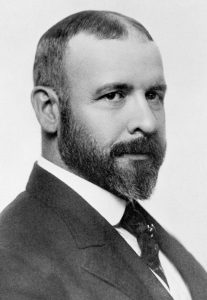
Louis Sullivan at age 35
Called by some “the father of the modern skyscraper,” few historical figures in the annals of modern architecture are as revered as Louis Henri Sullivan. Earning renown in his adopted city of Chicago, his influence in the field was indeed profound, his one-time employee and pupil, Frank Lloyd Wright, referring to him as “beloved Master.”
Despite his identification with the Midwest, Sullivan’s story begins in Boston, where he was born in 1856. His father, Patrick Sullivan, an Irish immigrant, sought with only mixed success to make a living as a dance teacher. As he traveled New England and beyond in search of students, Louis’ mother worked with him accompanying his instruction as a pianist. As a consequence, Louis and his brother spent a large portion of their youth on a farm which her Swiss immigrant parents had purchased in Wakefield. While often bored with school, Louis loved to roam the rural area, observing the natural world.
With his parents’ return to Boston, Louis moved into their residence on Bennet Street near the present Tufts Medical Center. While his education continued at a local public school, Louis began to take a special interest in the city’s urban landscape and its varied styles of architecture from different eras. He was intrigued by workmen at construction sites, observing carefully the materials they used and the intricate stonework employed to adorn building facades. With characteristic boldness, he pronounced at age 12 his intention to become an architect.
The departure of Louis’ parents from Boston led to his return to his grandparents’ farm in Wakefield. Completing eighth garde in grammar school, he was determined to enroll at a school that would provide him with practical abilities in math and science conducive to his chosen career path, rather than the study of Latin or the classics. After passing its entrance exam, at age 14 he began freshman year at English High School in 1870. This decision involved no small measure of sacrifice; the trip entailed a mile walk from the farm to the Wakefield train station and a longer walk still to the Bedford Street school after disembarking.
At English High Louis encountered a teacher who was to have a profound impact upon him. From Moses Woolson, that year’s “master,” he absorbed a curriculum of botany, mineralogy, English literature, algebra, geometry, and French. Most importantly, through Woolson’s encouragement and example, he learned to speak up and engage in debate to the end of promoting independent thought. He later warmly described his teacher as a lover of nature, skilled in the analysis of literature, and able to make difficult issues clear.
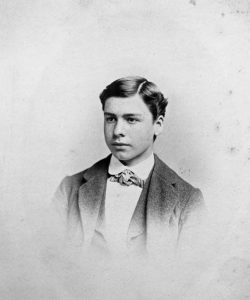
Louis Sullivan age 15
Louis returned to the school and completed his second year, assigned instruction by a “sub-master” whom he found less inspiring than Mr. Woolson. During that summer he learned from a friend of the newly opened school of architecture at “the Tech,” as Mass. Institute of Technology was then referred. Surprised to learn that admission did not require a high school diploma, Louis took and passed the school’s entrance exam. Impatient as always to move ahead, he concluded his English High years and began studies at M.I.T.
Louis found the college not wholly to his liking. While he enjoyed having more freedom than in high school, at age sixteen he was several years younger than his classmates. More importantly, he bristled at the instruction of the school’s professors, whom he felt demonstrated an overly rigid adherence to traditional forms of architecture. None of his subsequent teachers inspired him as much as Moses Woolson, one of his biographers noting that Louis’ first year at English High had been perhaps the most significant year of all his education.
Again restless, Louis decided after one year that pursuing his career now required engagement in the field rather than continued study. He left for Philadelphia where he was able to secure a position with an architectural firm. After some friction with a partner in the firm, Louis decided in 1873 to relocate to Chicago where his parents and brother were residing. He sought out one of the most admired architects of the day, William LeBaron Jenney, who was impressed with the young man’s ideas and energy and took him on with his firm.
Chicago presented an ambitious architect a unique opportunity. The Great Fire only two years earlier had leveled four square miles of the city center, presenting, as it were, a blank canvas for creative ideas in architecture. Further, that the downtown effectively was hemmed in by waterways and a network of railroads dictated attention to vertical growth of new structures. Louis avidly embraced the idea of building soaring structures, with Jenney’s firm pioneering the use of steel frame structures.
After a year with the firm and a brief period of study in Paris, Louis joined a different Chicago firm, in which he rose to partner in 1880, Adler & Sullivan. As his career advanced, Louis gained increasing notoriety for his innovation in architectural design. Drawing on all of his technical knowledge as well as inspiration from the natural world, he sought to infuse each structure with vitality, employing plaster, terra cotta, and iron work to embellish his creations.
As his firm drew more and more commissions, Sullivan’s architectural works, theaters and auditoria as well as skyscrapers, arose in numerous cities across the United States, each bearing the stamp of his own care in ornamentation and design. In envisioning and then bringing to life each new structure, he was guided by the maxim he coined that was to become a dictate of modern architecture: “form follows function.”
Despite this huge success, Sullivan’s later years were not to be happy ones. The panic of 1893 substantially curtailed commissions for new building construction to the point where the Adler & Sullivan partnership disbanded. Further, the style of architecture which became ascendant, neoclassicism of the Beaux-Arts style, was actively disfavored by Sullivan, who had always regarded it as unnecessarily derivative and unoriginal. His outspokenness in voicing profound displeasure with works that he considered lacking in inspiration contributed8 to further professional decline.
Commissions continued trickling in, mostly for smaller structures which continued to reflect his distinctive style. Sullivan’s heyday, however, had ended. As his uncompromising nature drove away potential customers, he experienced a steady descent into worsening alcoholism. He was forced to sell off most of his belongings and moved into a single room in an inexpensive hotel where he lived out his last years, dying in 1924.
Increased recognition of Sullivan’s immense talents began soon after his death. Near his simple grave, a group of friends, including prominent architects funded a granite memorial, with an inscription commemorating his singular contribution to American architecture. Perhaps Sullivan’s own words most aptly sum up the essence of that contribution: “the architect who combines in his being the powers of vision, of imagination, of intellect, of sympathy with human needs and the power to interpret them…is he who should create poems in stone.”
Sources for this article include “Father of Skyscrapers: A Biography of Louis Sullivan,” by Mervyn Kaufman, and Louis Sullivan ‘s “The Autobiography of an Idea.”
Tom Connors ’68 has authored several newsletter articles on noted alumni.
”
